The Real Problem Isn’t Stress
We don’t have a stress problem.
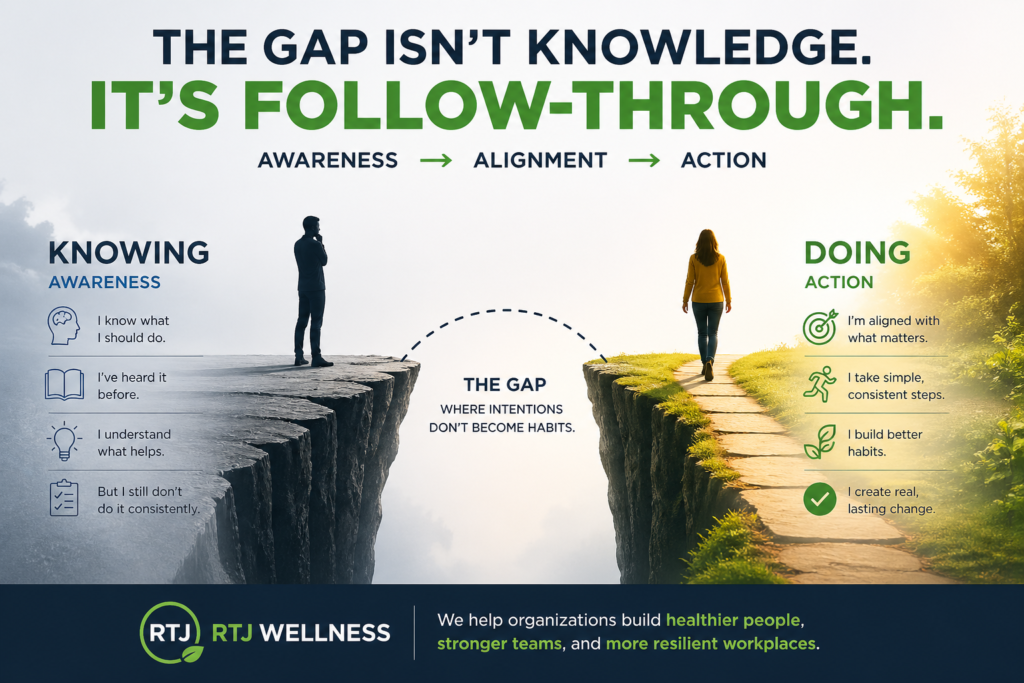
We have a follow-through problem.
That insight continues to show up across workplaces, regardless of industry, role, or experience level.
Because when you look at it honestly, most people already know what helps:
- Move more
- Sleep better
- Eat well
- Try to manage stress
There’s no shortage of information.
And yet, the same pattern keeps repeating:
Good people.
Putting in effort.
Still feeling overwhelmed, tired, and stuck.
So what’s missing?
Why Workplace Wellness Programs Often Fall Short
Most workplace wellness programs focus on awareness.
- Lunch-and-learns
- Guest speakers
- Educational resources
These are valuable but they often don’t lead to lasting change.
Research in behavior change shows that knowledge alone is rarely enough to change habits (Michie et al., 2011; Gollwitzer, 1999).
People don’t struggle because they don’t know what to do.
They struggle with consistently doing it.
That gap between knowing and doing is where most wellness initiatives break down.
The Missing Link: Alignment
The key issue isn’t effort it’s alignment.
When daily actions are disconnected from what actually matters to someone, consistency drops off quickly.
This isn’t a motivation problem.
It’s a relevance problem.
If someone is told to “manage stress,” but their daily routines don’t connect to their values or priorities, even the best strategies won’t stick.
But when actions are aligned with something meaningful, behavior becomes far more sustainable.
Not perfect but consistent.
And consistency is what drives real change.
A Simple Framework That Improves Follow-Through
Instead of overwhelming people with more strategies, a simpler approach tends to work better.
Start here:
- Identify one meaningful priority (your “why”)
- Write down a few actions to start or increase
- Write down a few actions to reduce or eliminate
- Commit to one small, daily promise
This takes just a few minutes.
But it shifts the focus from “What should I do?” to “What actually matters to me?”
That shift is where follow-through begins.From Information to Behavior Change
A common challenge in workplace wellness is this:
Information is delivered.
People understand it.
But it doesn’t stick.
This isn’t a failure of the individual.
It’s a limitation of the delivery.
In our experience working with thousands of participants across workplaces, a different approach produces better results.
What Makes Wellness Programs More Effective
Three elements consistently improve engagement and follow-through:
1. Practical, Science-Informed Strategies
Simple tools that people can use immediately just concepts they understand.
2. Immersive-Based Experiences
Interactive tools like The Wellness Audit and “Your Magic Number” create reflection, discussion, and shared accountability.
3. Experiential Learning
People are far more likely to apply what they experience than what they simply hear.
This is supported by learning research showing that active learning improves retention and application (Freeman et al., 2014).
When learning becomes interactive and relevant, it becomes actionable.
The Shift That Matters Most
If there’s one shift that makes the biggest difference, it’s this:
Move from awareness to application.
Not more information.
Not more reminders.
But better alignment, simpler systems, and more immersive and engaging ways to learn.
Because most people don’t need more advice.
They need support in following through. Question for Leaders and HR Teams
If you’re responsible for wellness in your organization, consider this:
Are your current initiatives creating awareness…or actual behavior change?
One feels productive.
The other produces results.
Final Thought: Build a Life That Reduces Stress
Stress isn’t going away.
Work demands aren’t going away.
But when people are aligned with what matters, and supported with practical, engaging tools, their ability to handle those demands improves.
Less focus on doing more.
More focus on doing what matters.
Consistently.
Looking to Improve Your Workplace Wellness Strategy?
If you’re exploring ways to make your wellness initiatives more engaging, practical, and results-driven, it may be time to rethink the approach, not just the content.
A short conversation is often the easiest place to start.